
Sketch to Garment AI: How Designers Can Turn Concepts into Realistic Clothing Visuals?
Sketch to garment AI helps designers convert fashion sketches, flat drawings, and early design concepts into realistic clothing visuals using artificial intelligence. It gives fashion teams a faster way to preview silhouettes, fabrics, textures, colors, and styling directions before creating samples or planning photoshoots.
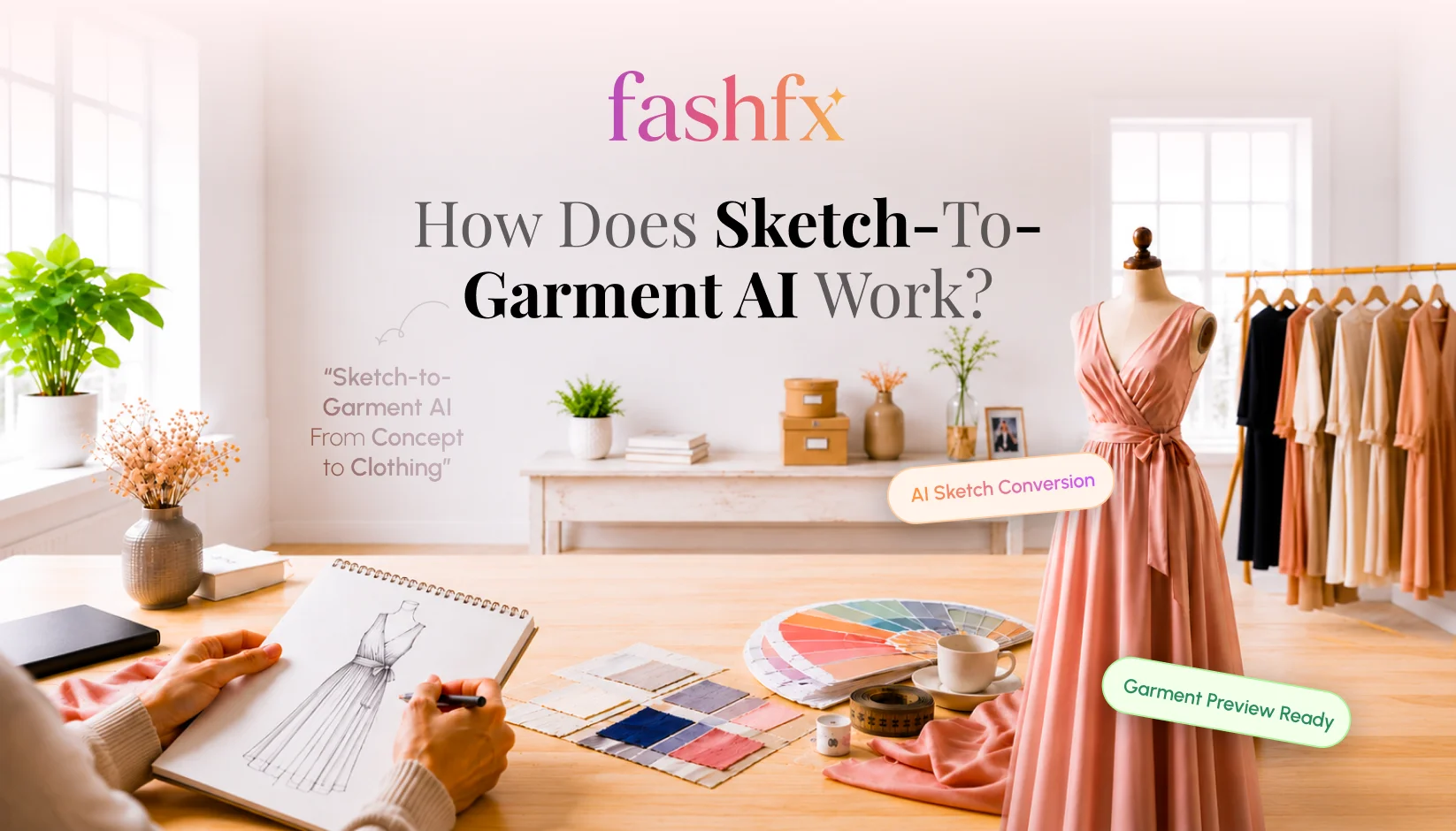
Fashion ideas often begin as rough lines on paper, quick digital sketches, moodboard references, or technical flats. But before a garment reaches the runway, catalog, ecommerce page, or campaign shoot, designers need one thing: a realistic visual that clearly shows how the concept may look in real life.
That is where sketch to garment AI changes the workflow.
Sketch to garment AI helps designers convert fashion sketches, flat drawings, and early design concepts into realistic clothing visuals using artificial intelligence. It gives fashion teams a faster way to preview silhouettes, fabrics, textures, colors, and styling directions before creating samples or planning photoshoots.
Generative AI is already becoming relevant across fashion design, marketing, product discovery, and visual content creation. McKinsey reported that generative AI can help fashion businesses become more productive, get to market faster, and serve customers better.
TL;DR: What Designers Should Know
- Sketch to garment AI turns fashion sketches into realistic clothing visuals.
- It helps designers visualize concepts before sampling or production.
- AI garment visualization supports faster reviews, approvals, and campaign planning.
- Designers can test colors, fabrics, silhouettes, and styling directions faster.
- It does not replace fashion designers, pattern makers, or production teams.
- It works best with clear sketches, strong prompts, and design references.
- FashFX helps designers move from sketch to garment, model shot, and fashion video.
What Is Sketch to Garment AI?
Sketch to garment AI is an AI-powered fashion visualization process that converts a clothing sketch into a realistic garment image.
A designer can upload a rough sketch, technical drawing, fashion illustration, or flat garment outline. The AI studies the shape, neckline, sleeves, length, proportion, seams, fit, and visible design details. Then it generates a more realistic fashion visual that can show fabric feel, folds, lighting, styling, and product presentation.
In simple terms:
Sketch → AI garment visual → model-ready fashion content
This process is also known as fashion sketch to image AI, AI garment visualization, AI clothing design generator, sketch to clothing AI, or AI fashion design visualization.
Why Traditional Fashion Visualization Slows Designers Down
Traditional fashion design workflows are creative but often slow.
A designer may start with a sketch, create a technical flat, share it with internal teams, wait for feedback, prepare a sample, adjust the pattern, revise the fit, and then plan photography or digital presentation. Each stage takes time, money, and coordination.
The challenge is not the sketch itself. The challenge is that sketches are not always easy for everyone to understand.
A merchandiser may focus on market fit.
A founder may focus on collection direction.
A buyer may want a realistic preview.
A marketing team may need campaign visuals.
An ecommerce team may need catalog-ready images.
AI fashion visualization helps bridge this communication gap. It turns early creative ideas into visuals that more teams can understand, review, and approve.
How Does Sketch to Garment AI Work?
Sketch to garment AI works by combining visual interpretation with generative image creation.
The process usually follows four steps.
1. Upload the Fashion Sketch
The designer uploads a sketch, flat drawing, technical illustration, or reference image. Clear outlines, visible garment structure, and defined proportions usually help the AI produce better results.
2. Add Design Instructions
The designer writes a prompt describing the garment type, fabric, color, fit, silhouette, texture, pattern, and desired output style.
Example: “Convert this flat sketch into a realistic women’s structured blazer. Preserve the lapel shape, sleeve length, waist fit, seams, and front buttons. Use cream wool fabric, natural folds, studio lighting, and a clean catalog background.”
3. Generate the Garment Visual
The AI creates a realistic clothing visual based on the sketch and prompt. The output may show fabric behavior, lighting, shape, texture, folds, and styling direction.
4. Refine the Output
The designer can refine the result by changing colors, adjusting fabric type, improving structure, adding styling details, or preparing the visual for model placement, ecommerce, or campaign use.
Sketch to Garment AI vs Traditional Workflow
| Workflow Area | Traditional Fashion Visualization | Sketch to Garment AI |
|---|---|---|
| Starting point | Sketch, flat drawing, or illustration | Sketch, flat drawing, or illustration |
| Visual output | Manual illustration, sample, or photoshoot | AI-generated realistic garment visual |
| Speed | Slower due to sampling and revisions | Faster for early visual exploration |
| Cost impact | Higher when many samples are needed | Can reduce early-stage visual dependency on samples |
| Best use | Final production, fit, construction, quality checks | Concept previews, presentations, styling, campaign planning |
| Human role | Designer-led | Still designer-led |
| Production accuracy | Strong when handled by technical teams | Needs designer review and validation |
AI does not remove the need for technical design, sampling, fitting, or production review. It simply gives fashion teams a faster visual layer before investing in deeper development.
Benefits of Sketch to Garment AI for Fashion Designers
1. Faster Concept Visualization
Sketch to garment AI helps designers move from idea to visual much faster.
Instead of waiting for manual rendering or early samples, designers can preview how a dress, jacket, shirt, co-ord set, or accessory may look with realistic fabric and styling details.
This is especially useful during early collection planning, buyer presentations, design reviews, and campaign concept development.
2. Better Design Communication
A sketch can be interpreted in many ways. A realistic garment visual creates a shared reference for designers, founders, merchandisers, marketers, and ecommerce teams.
This makes feedback clearer because everyone is looking at a more complete visual direction.
3. Reduced Early Sampling Dependency
Physical samples are still essential for fit, production, fabric testing, and final quality checks.
However, AI-generated garment visuals can help teams shortlist ideas before creating multiple early samples. This can support smarter decision-making during concept selection.
4. More Room for Creative Iteration
Designers can test multiple versions of the same concept.
For example, one sketch can be visualized as:
- A satin evening dress
- A cotton summer dress
- A denim jacket
- A linen co-ord set
- A printed resortwear piece
- A streetwear-inspired oversized fit
This helps designers explore creative possibilities without redrawing the entire concept every time.
5. Faster Marketing and Ecommerce Planning
Once a garment visual is ready, fashion teams can extend it into model shots, virtual try-on images, catalog visuals, campaign creatives, reels, or AI fashion videos.
Reuters reported that Zalando used generative AI to reduce image production timelines from six to eight weeks to three to four days, while cutting related costs by 90%, according to company statements.
What Can Designers Create with Sketch to Garment AI?
Designers can use AI garment visualization for many fashion categories.
Apparel
Dresses, shirts, t-shirts, jackets, hoodies, pants, jeans, shorts, skirts, suits, ethnic wear, activewear, co-ord sets, and outerwear.
Footwear
Sneakers, heels, sandals, boots, loafers, formal shoes, and casual footwear concepts.
Jewellery
Necklaces, earrings, bracelets, rings, anklets, and styled jewellery looks.
Accessories
Bags, belts, scarves, sunglasses, watches, hats, caps, and fashion styling add-ons.
Campaign Assets
AI-generated garment visuals can also support model shots, product-to-model images, lookbooks, ad creatives, social posts, and fashion videos.
Real-World Use Cases of Sketch to Garment AI
Fashion Designers
Designers can turn sketches into realistic visuals for presentations, collection planning, and creative exploration.
Fashion Brands
Brands can preview seasonal collections, test product ideas, and align design, marketing, and ecommerce teams faster.
Retailers
Retailers can visualize product concepts before building catalog assets or planning merchandising campaigns.
Ecommerce Stores
Ecommerce teams can use AI fashion visualization to create cleaner product visuals and prepare faster product launch content.
Marketing Teams
Marketing teams can turn static garment visuals into campaign-ready images, reels, and promotional creatives.
Creative Agencies
Agencies can use sketch to garment AI to create moodboards, campaign concepts, model visuals, and branded fashion content faster.
What Makes a Good AI Fashion Sketch?
A good sketch to garment AI output starts with good input.
Designers should use sketches with clear garment outlines, visible proportions, defined neckline, sleeve shape, hemline, seams, and major design details.
A good prompt should include:
- Garment type
- Fabric type
- Color
- Fit
- Silhouette
- Pattern
- Texture
- Sleeve style
- Neckline
- Length
- Design details
- Lighting style
- Background style
- Model requirement, if needed
Example Prompt
“Convert this flat fashion sketch into a realistic clothing visual. Preserve the silhouette, neckline, sleeve shape, seam lines, proportions, and design details. Use soft beige linen fabric with natural folds, clean studio lighting, and a catalog-ready product look.”
Is Sketch to Garment AI Accurate?
Sketch to garment AI can create realistic visuals, but the result should always be reviewed by a designer.
AI can help visualize garment direction, fabric mood, styling, and presentation. But it may not always understand construction details perfectly. Final production decisions still require fashion designers, technical designers, pattern makers, and fabric experts.
The safest way to use AI garment visualization is as a creative and presentation tool, not as a replacement for technical production validation.
How FashFX Helps Designers Go From Sketch to Campaign
FashFX helps fashion teams create AI-powered fashion visuals from sketches, product images, and styling concepts.
Designers can use FashFX to turn flat sketches into realistic garment visuals, place products on models, create virtual try-on images, swap models in campaign visuals, style multiple fashion assets together, and generate AI fashion videos.
The value is not limited to one visual. A designer can start with a concept sketch, turn it into a realistic garment visual, place it on a model, style it with accessories, and prepare campaign-ready content for ecommerce, ads, reels, or lookbooks.
For fashion teams, this creates a smoother workflow:
Sketch → Garment visual → Model shot → Campaign creative → Fashion video
This helps designers, brands, retailers, ecommerce teams, marketing teams, and creative agencies build visual content faster without depending on a traditional photoshoot for every early-stage idea.
Future of Sketch to Garment AI in Fashion Design
AI fashion visualization is becoming a practical part of modern fashion workflows.
McKinsey’s State of Fashion 2026 report notes that more than 35% of fashion executives reported using generative AI in areas such as online customer service, image creation, copywriting, consumer search, or product discovery.
The future of sketch to garment AI is not about replacing creativity. It is about helping fashion teams move faster from imagination to execution.
Designers will still define the taste, silhouette, construction, brand language, and creative direction. AI will help them visualize, test, refine, and present those ideas faster.
Conclusion
Sketch to garment AI gives designers a faster way to turn concepts into realistic clothing visuals.
It helps fashion teams move beyond flat sketches and static references by creating visuals that can support collection planning, client presentations, ecommerce launches, campaign previews, and fashion content creation.
For designers, the benefit is clear: more visual clarity, faster iteration, stronger communication, and better creative control before production begins.
With FashFX, fashion teams can take a sketch and move it through the full visual journey, from garment concept to model-ready image to campaign-ready fashion video.
Start Creating with FashFX
Turn early fashion ideas into realistic garment visuals ready for review and collection planning.
Get Started
Frequently
Asked Questions
Have questions about Sketch to Garment AI: How Designers Can Turn Concepts into Realistic Clothing Visuals?? We answer them here
Sketch to garment AI is a process that uses artificial intelligence to convert fashion sketches, flat drawings, or clothing concepts into realistic garment visuals.

Ready to Redesign Your Content Pipeline?
Use FashFX to visualize your products and create photorealistic models in seconds.
Try FashFX Now