
How AI Is Transforming the Fashion Industry in 2026
Explore how AI is changing fashion design, photography, marketing, ecommerce, virtual try-on, forecasting, and retail operations in 2026.
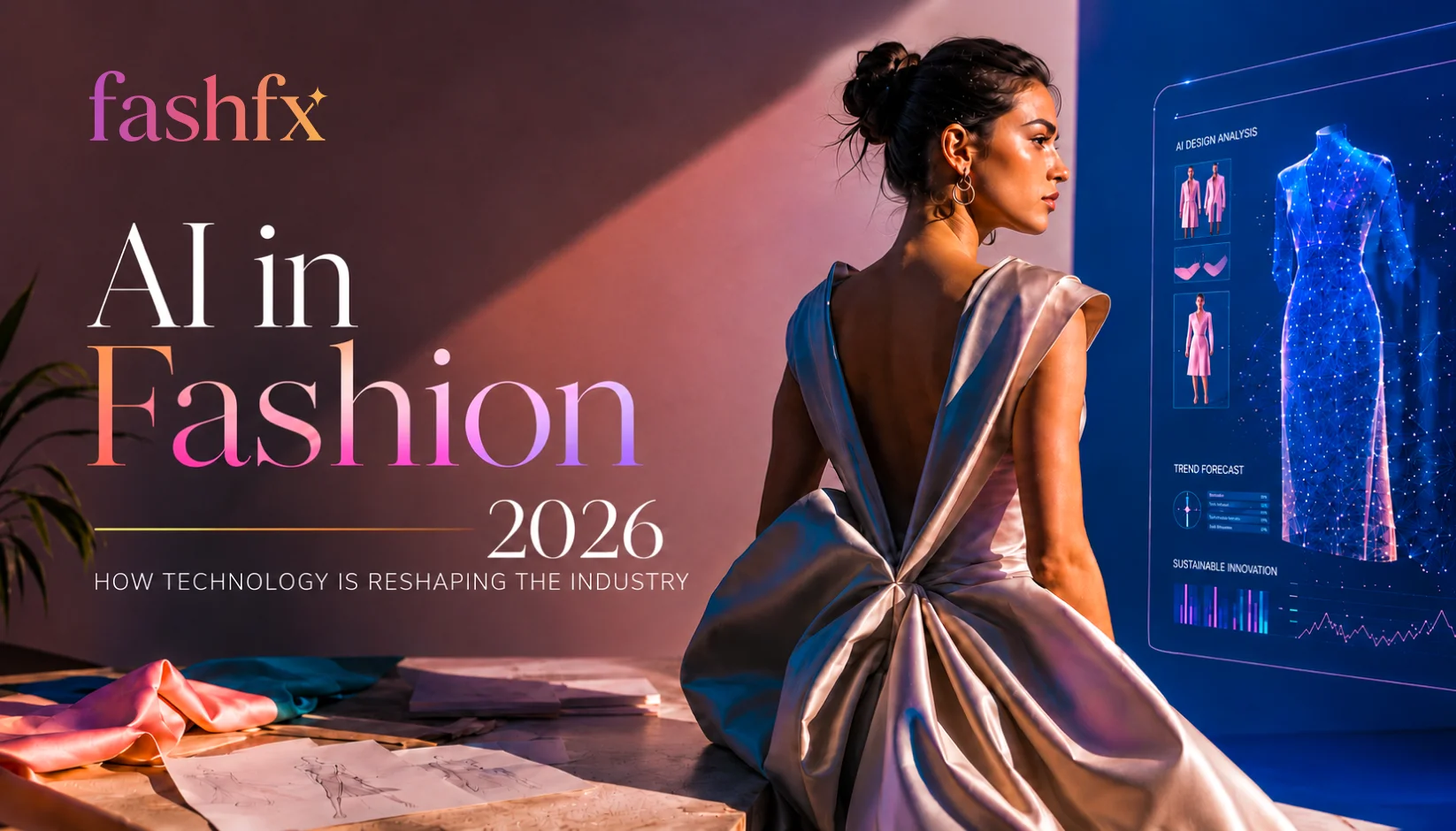
Artificial intelligence is transforming the fashion industry by helping brands design products, create campaign content, personalise shopping experiences, forecast demand, and automate repetitive work.
According to the State of Fashion 2026 report from McKinsey and The Business of Fashion, more than 35% of surveyed fashion executives already use generative AI in areas such as image creation, copywriting, online customer service, consumer search, and product discovery.
The biggest change is not that AI is taking over fashion. It is that designers, ecommerce teams, retailers, and marketers can now explore and produce more options within the same workflow.
A product image can become an on-model visual. A sketch can become a realistic garment concept. A still campaign image can become a short fashion video. Product data can power personalised recommendations, while forecasting systems can help planning teams make better inventory decisions.
AI in fashion has therefore moved beyond experimental image generation. It is becoming part of how fashion products are imagined, presented, discovered, marketed, and sold.
Key Takeaways
- AI now supports fashion design, garment visualisation, content production, marketing, ecommerce, customer service, forecasting, and product discovery.
- More than 35% of fashion executives report using generative AI for functions such as image creation, copywriting, customer service, search, or product discovery.
- Fashion brands can turn sketches, swatches, product images, and existing campaign assets into new visual concepts.
- Virtual try-on technology helps shoppers or fashion teams preview garments on different people without first arranging a complete photoshoot.
- AI can automate repetitive production work, but designers, marketers, and merchandisers must still review product accuracy, brand consistency, and usage rights.
- Agentic shopping, conversational product discovery, image-to-video generation, and AI content transparency are major AI fashion trends in 2026.
How Do Fashion Brands Use AI in 2026?
Fashion companies use AI across design, product development, marketing, ecommerce, merchandising, operations, and customer experience.
Here are the areas where AI is creating the most visible change:
1. AI Fashion Design Accelerates Early Concept Development
AI fashion design tools help designers explore colours, silhouettes, materials, prints, and styling directions before producing a physical sample.
A designer can begin with a written prompt, garment sketch, technical flat, fabric swatch, reference image, or existing product. The system can then generate visual variations based on those inputs.
This makes AI useful during early ideation because teams can compare multiple creative directions before choosing which ideas deserve further development.
AI clothing design does not remove the need for professional designers. Generated images may not include accurate construction details, measurements, stitching instructions, fabric behaviour, or manufacturing specifications. Designers and technical teams must still determine whether a concept can be made, fitted, sourced, and produced.
The practical role of AI is to expand visual exploration while allowing designers to keep control of the final decision.
2. AI Turns Sketches and Swatches into Garment Visuals
Traditional garment development often requires several stages before a team can clearly visualise the final product. AI garment generation can shorten the early visualisation stage.
For example, a fashion team can upload:
- A hand-drawn sketch
- A technical flat
- A fabric pattern
- A colour reference
- A textile swatch
- An existing silhouette
The system can then generate a realistic garment concept for internal review, collection planning, buyer presentations, or early campaign preparation.
These outputs should be treated as visual concepts rather than confirmed production specifications. Fabric weight, pattern placement, seams, sizing, and construction must still be checked by experienced product teams.
3. AI Reduces Dependence on Physical Prototypes
AI-generated previews and digital garment concepts allow teams to review more ideas before commissioning physical samples.
This does not make physical samples unnecessary. Samples remain important for checking construction, fit, comfort, fabric performance, colour accuracy, and production quality.
However, digital review can help teams reject weak directions earlier. McKinsey notes that reimagining prototyping with AI can accelerate parts of the process and reduce the number of physical prototypes required, provided human creativity and product expertise remain central.
4. AI Fashion Photography Changes Content Production
AI fashion photography allows brands to create or adapt visual assets using product images, model references, and creative instructions.
Depending on the tool and input quality, fashion teams may use AI to:
- Place garments on selected models
- Generate different model or styling options
- Change campaign backgrounds
- Create studio-style product scenes
- Produce lifestyle campaign concepts
- Refresh an existing campaign layout
- Adapt visuals for different platforms
- Generate short videos from still images
This gives brands more flexibility when producing content for product pages, marketplaces, social media, email campaigns, digital advertisements, and seasonal promotions.
5. AI Product Photography Creates More Campaign Variations
Traditional product photography remains important when exact colour, texture, fit, or construction must be documented. However, AI product photography can extend the value of an existing product image.
A single packshot may be used to create:
- Styled product scenes
- Lifestyle backgrounds
- Promotional layouts
- On-model presentations
- Seasonal campaign concepts
- Social advertisements
- Catalogue variations
- Short promotional videos
This approach is particularly useful when a fashion brand needs multiple creative formats for several channels.
Every generated asset should be checked against the physical product. Incorrect patterns, missing fasteners, altered logos, unrealistic folds, or changed colours can misrepresent what customers will receive.
6. Generative AI Supports Fashion Content Automation
Fashion content automation uses AI to accelerate repetitive content tasks while maintaining a human approval process.
Marketing teams may use it to prepare:
- Product descriptions
- Campaign headlines
- Social media captions
- Advertising variations
- Email subject lines
- Search-friendly category content
- Visual resizing instructions
- Regional content adaptations
- Product videos and motion assets
The main advantage is content scalability. One approved campaign direction can be adapted into several formats without rebuilding every asset from the beginning.
7. AI Is Personalising Fashion Marketing
AI fashion marketing uses customer and product information to make campaigns more relevant to different audiences.
Possible applications include:
- Audience segmentation
- Personalised product recommendations
- Dynamic email content
- Region-specific campaigns
- Customer-service chatbots
- Retargeting messages
- Product pairing suggestions
- Personalised landing pages
- Search and discovery support
Generative AI can also help marketing teams produce several creative versions for different platforms or audience groups. However, personalisation depends on reliable data, suitable consent practices, and careful testing.
AI-generated personalisation should support the customer journey without becoming intrusive or misleading.
8. AI Is Improving Fashion Ecommerce Discovery
AI fashion ecommerce is moving product discovery away from rigid keyword searches and long product lists.
Instead of searching only for "black dress," a customer may ask:
"Show me a black dress suitable for a summer evening event under $150."
Conversational systems can interpret the request, examine product information, and suggest relevant items. Visual search can also help shoppers find products that resemble an uploaded image.
McKinsey reports that consumers are increasingly turning to AI assistants for product advice and brand discovery. It recommends that brands improve semantically rich product information and ensure their digital systems can communicate effectively with AI-powered services.
This creates a new requirement for fashion ecommerce teams. Product pages must be readable by people, search engines, and AI systems.
Useful product data should clearly describe:
- Garment type
- Material
- Colour
- Pattern
- Fit
- Size availability
- Use occasion
- Care instructions
- Price
- Stock status
- Delivery information
- Product compatibility
9. Virtual Try-On Technology Makes Products Easier to Visualise
AI-powered virtual try-on uses product and human images to show how clothing or accessories may look on a selected person or model.
There are two common applications:
- Customer-Facing Virtual Try-On: A shopper uploads a photo or selects a model to preview an item before buying. Google expanded its virtual apparel try-on capability to India and the United Kingdom in December 2025. The tool allows shoppers to upload a photo and preview tops, bottoms, dresses, jackets, and shoes. Google states that its fashion model accounts for details such as how materials fold, stretch, and drape.
- Brand-Facing Virtual Try-On: Fashion teams upload product images and place the items on selected models to create on-model visuals for catalogues, presentations, or campaigns.
The output is a visual representation, not a guaranteed sizing or fit assessment. Unless the system has accurate body measurements, garment measurements, material data, and fit validation, brands should not present it as proof of exact physical fit.
10. AI Supports Demand Forecasting and Inventory Planning
Predictive AI can analyse historical demand, location, seasonality, product performance, customer behaviour, and other variables to support merchandising decisions.
Better forecasting can help a fashion business decide:
- How much inventory to order
- Which products to stock by location
- When to replenish an item
- Which styles need promotion
- Which products may sell slowly
- Where demand may be increasing
McKinsey identifies demand forecasting and planning as areas where AI can support improved sell-through, reduce stock shortages, and limit excess inventory. These outcomes depend on data quality, operating processes, and the accuracy of the selected forecasting model.
11. AI Is Changing Customer Service
Fashion retailers use AI assistants to answer common questions about products, sizing, delivery, returns, availability, and care instructions.
More advanced systems can combine customer questions with catalogue information to suggest relevant products. Some can remember stated preferences within a session and refine their recommendations as the conversation continues.
Human support remains necessary for complex complaints, payment disputes, accessibility requirements, unusual fit questions, and situations requiring judgement or empathy.
12. AI Can Support Fashion Resale and Authentication
Computer vision and data analysis can help resale platforms examine product images, descriptions, historical listings, and known product characteristics.
However, AI should not be treated as conclusive proof that an item is genuine. High-value products may still require documentation, expert review, or physical inspection.
What Are the Benefits of AI in Fashion?
The benefits of AI depend on the use case, input quality, workflow, and level of human review.
| Benefit | How AI Can Help |
|---|---|
| Faster concept exploration | Generates several visual directions from sketches, swatches, images, or prompts |
| More content variations | Adapts approved ideas for ecommerce, social media, advertising, and campaigns |
| Earlier product visualisation | Helps teams review garment concepts before all physical samples are available |
| Improved product discovery | Uses conversational, visual, and personalised search |
| Better catalogue presentation | Creates additional on-model, styled, or motion-based product assets |
| More informed planning | Analyses demand, sales, inventory, and customer behaviour |
| Reduced repetitive work | Automates selected content, support, and production tasks |
| Greater testing capacity | Allows teams to compare more creative or product variations |
| Regional adaptability | Helps prepare language, model, styling, or campaign variations for different markets |
These are potential benefits, not guaranteed results. Brands should measure their own production time, approval rates, product accuracy, engagement, conversion, returns, and cost per approved asset.
What Are the Latest AI Fashion Trends in 2026?
Major innovations in AI technology are reshaping creative production and retail operations in 2026.
1. Agentic Fashion Shopping
AI assistants are beginning to move from answering questions to helping consumers compare, monitor, select, and purchase products.
The technology is still developing, but McKinsey identifies agentic commerce as an important direction for fashion retail technology in 2026.
2. Generative Engine Optimization
Fashion brands are beginning to consider how their products appear in answers generated by AI assistants.
Generative engine optimization, or GEO, requires clear product data, useful editorial content, credible third-party mentions, structured information, and technically accessible ecommerce systems.
3. Image-to-Video Fashion Content
Fashion teams can now add controlled motion to still product or model images. This supports reels, digital advertisements, product pages, and campaign teasers without filming every variation separately.
Human reviewers must inspect garment edges, prints, faces, hands, logos, backgrounds, and movement consistency before publishing.
4. Fashion-Specific Generative Models
General-purpose image tools do not always understand fabric behaviour or garment construction. Fashion-specific models are being developed to better interpret drape, texture, folds, body shape, and product placement.
Google states that its virtual try-on model was developed to understand how different materials fold, stretch, and drape across different bodies.
5. Digital Models and Digital Twins
Some companies are experimenting with high-fidelity digital versions of real models for campaign production. These systems require clear consent, contractual agreements, usage limits, compensation policies, and identity protection.
6. AI-Generated Campaign Production at Scale
Fashion AI tools are moving from one-off experiments to connected workflows covering product visuals, model shots, campaign adaptations, descriptions, and video.
The emphasis is shifting from generating one attractive image to producing multiple usable assets while preserving the product and brand direction.
7. Greater AI Content Transparency
From 2 August 2026, transparency obligations under Article 50 of the EU AI Act begin applying to certain AI-generated and manipulated content. The requirements cover machine-readable marking by providers and disclosures for defined forms of synthetic content, including deepfakes. The exact obligation depends on the content and how it is used.
Fashion brands operating in the EU should obtain legal advice for their specific campaigns rather than assuming that one disclosure rule applies to every image.
How FashFX Supports AI Fashion Content Creation
FashFX is an AI fashion studio built for designers, fashion brands, ecommerce stores, retailers, marketing teams, and creative agencies.
It brings several fashion content workflows into one platform:
- AI Virtual Try-On: Place apparel, footwear, jewellery, and accessories on selected models.
- AI Garment Generation: Turn sketches, technical flats, and fabric swatches into garment and collection visuals.
- AI Design Studio: Change campaign models, transfer poses, and refresh layouts without organising another shoot.
- AI Video Generation: Add motion to still fashion images for advertisements, reels, and product pages.
- AI Product Campaigns: Create studio-style, lifestyle, and social campaign visuals from product images.
These capabilities are documented on the official FashFX Solutions page.
FashFX does not remove the need for creative direction or product review. It gives fashion teams another production route when they need to explore designs, create more content, or adapt existing assets without rebuilding the complete production setup.
The Future of Fashion Technology
The future of fashion technology is not simply about generating more images. It is about connecting design, product information, content production, ecommerce, personalization, and planning.
In 2026, the strongest fashion AI workflows combine three elements:
- Reliable product and customer data
- AI tools suited to a clearly defined task
- Human judgement at every important approval point
Brands that treat AI as an uncontrolled shortcut may produce inaccurate products, generic campaigns, or compliance risks. Brands that treat it as a governed creative and operational system can test more ideas, prepare more relevant content, and respond faster to changing demand.
AI will continue to change how fashion is designed, presented, discovered, and purchased. Human creativity, product knowledge, and brand perspective will determine whether that technology creates lasting value.
Start Creating with FashFX
Turn early fashion ideas into realistic garment visuals ready for review and collection planning.
Get Started
Frequently
Asked Questions
Have questions about How AI Is Transforming the Fashion Industry in 2026? We answer them here
AI is transforming fashion by supporting design visualisation, product content, virtual try-on, personalised marketing, conversational shopping, customer service, forecasting, and inventory planning. More than 35% of surveyed fashion executives already use generative AI in selected functions, according to the State of Fashion 2026.

Ready to Redesign Your Content Pipeline?
Use FashFX to visualize your products and create photorealistic models in seconds.
Try FashFX Now